Korean Zucchini Pancake

Posted on

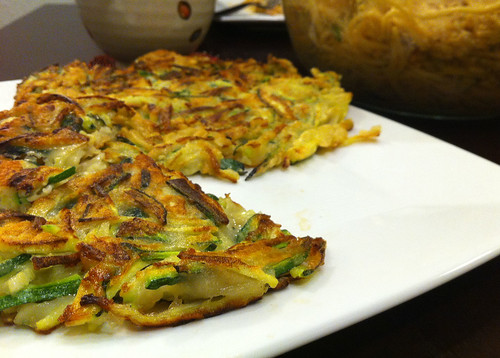
If you’ve been reading my blog for more than, say, five minutes, then you know I love Korean food. When my parents’ garden produced a giant bounty of zucchini last year, I turned to my favorite Korean food blog, maangchi.com, for inspiration. It was from there that I adapted a recipe for hobakjeon, or zucchini pancakes, served with a delicious dipping sauce. So easy and so delicious, these pancakes have become one of my favorite recipes ever since.

Korean zucchini pancake

Ingredients:

2 zucchini, julienned
1/2 cup flour
1/2 teaspoon salt
1/2 cup water
2 tablespoons vegetable oil (or more as needed)
1 tablespoon sesame oil (or more as needed)
2 tablespoon soy sauce
1 tablespoon rice vinegar
1/2 clove garlic, minced
1 chili pepper, sliced

1. Combine zucchini, flour, salt, and water in a bowl and mix well.

2. Heat the 2 tablespoons of vegetable oil in a frying pan on medium-high heat and place 1 cup of the batter in the pan, spreading evenly and thinly to make a large pancake. After two minutes, add 1 tablespoon of the sesame oil on the pan, along the edge of the pancake. Tilt and shake the pan so that the sesame oil spreads underneath the pancake. Cook another couple of minutes until the bottom turns light golden brown and crispy.

3. Carefully flip the pancake with a spatula and add another tablespoon of vegetable oil, if needed. Cook for another three to four minutes, until crispy. Transfer the pancake to a large serving plate and serve with dipping sauce.

4. To make the dipping sauce: In a small bowl mix the soy sauce, vinegar, garlic, and chili pepper. Serve alongside the warm pancake.

Fresh Spring Rolls with Peanut Dipping Sauce

Posted on

I make these light and healthy spring rolls all the time, especially when the weather begins to warm up. (Or when it never cools down, as is this case with this year’s endless Bay Area summer.)

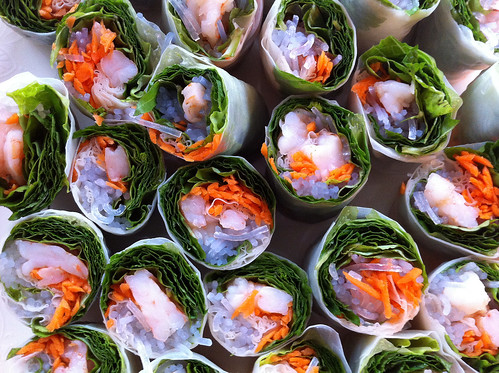
Even though I usually make them with shrimp, you can substitute with shredded chicken, fresh crab, or any kind of protein. The herbs are interchangeable too: I prefer a mix of romaine lettuce, mint, and basil, but anything goes. Sometimes I substitute shredded carrots with cucumbers or avocado instead. You get the picture.

Don’t make these too ahead of time, as I’ve learned the hard way that refrigerating fresh spring rolls results in a stale wrapper. Don’t worry, though. These are so good you won’t have any left over.

Shrimp spring rolls

Ingredients:

1/2 cup creamy peanut butter
1/4 cup chicken broth
2 tablespoons hoisin sauce
3 tablespoons soy sauce
1 tablespoon granulated sugar
2 teaspoons chile-garlic sauce
1 teaspoon toasted sesame oil
1 1/2 tablespoons rice vinegar
24 medium shrimp (about 1 pound), peeled (or shredded chicken)
4 ounces dried bean thread (glass) noodles
16 round rice paper wrappers
1 carrot, peeled and shredded
1 bunch mint leaves, removed from stems
1 bunch basil leaves, removed froms tems
1 Persian cucumber, peeled and julienned
1 bunch romaine lettuce, ribs removed

1. To make the peanut sauce, whisk the first 8 ingredients together in a medium bowl; set aside.

2. To make the spring rolls, bring a medium saucepan of water to a boil over high heat. Add the shrimp and cook until pink and opaque, about 2 minutes. Drain in a colander and run under cold water until cool. Pat the shrimp dry with paper towels and place on a cutting board. Holding your knife parallel to the cutting board, halve each shrimp horizontally. Set aside.

3. Bring 3 cups of water to a boil and pour over bean thread noodles in a heat-proof bowl and cover for 5 minutes. Drain and set aside.

4. Place a clean, damp kitchen towel on a work surface. Fill a medium frying pan or wide, shallow dish large enough to hold the rice paper wrappers with hot tap water. Working with 1 wrapper at a time, completely submerge the wrapper until it is soft and pliable, about 15 seconds. Remove the wrapper from the water and place it on the towel.
Working quickly, tear off a piece of lettuce that is roughly half the size of the wrapper and place in the center of the wrapper. Add 3 shrimp halves in a row, cut side up, just above the center of the wrapper, leaving about 1 inch of space on each side. Layer 1/4 cup of the noodles over the shrimp, followed by a spoon of carrot, a few mint leaves, and a few basil leaves. Place 2 of the cucumber sticks on either side of the noodle pile.

5. Fold the bottom and top halves of the rice paper wrapper over the filling. Holding the whole thing firmly in place, fold the sides of the wrapper in. Then, pressing firmly down to hold the folds in place, roll the entire wrapper horizontally up from the bottom to the top. Slice in half.

6. If not serving immediately, keep the summer rolls tightly covered with plastic wrap at room temperature for up to 2 hours. Serve with the peanut sauce for dipping.

Mast-o-Khiar (Persian Yogurt with Cucumber and Mint)

Posted on

Call it Greek tzatziki, Turkish cacik, or Indian raita, but to me, it’ll always be mast-o-khiar. It’s part of nearly every Iranian meal and couldn’t be easier to prepare. English translations will often call it a dip, and while it can be (raise your hand if you dipped your potato chips into mast-o-khiar while growing up), it’s really eaten as a side dish alongside a complete meal.

Mast-o-khiar can include variations like dried rose petals (how Persian, I know) or dried shallots (in which case it becomes mast-o-musir), but my favorite is this classic version, garnished with a light sprinkling of walnuts.

Mast-o-khiar

Ingredients:

2 cups Middle Eastern or Greek-style yogurt, plain
2 or 3 Persian cucumbers, finely chopped or grated
1 small garlic clove, minced
1 1/2 tablespoons ground dried mint
2 tablespoons walnuts, chopped (optional)
salt and pepper to taste

1. Mix all of the ingredients in a bowl, reserving half a tablespoon of walnuts for garnish. Chill and serve cold.

Kotlet (Iranian Cutlet)

Posted on

Kotlet, or Persian minced meat and potato croquettes, are an ubiquitous picnic meal in Iranian households. Growing up, I’d look forward to these in warm lavash sandwiches for lunch and now that I’m older, I prepare them as an appetizer or light meal. Kotlet are easy to make and can be frozen for reheating later on.

Serve these with pickled vegetables and sliced tomatoes, or simply on their own. Lightly spiced and crispy on the outside, it’s nearly impossible to eat just one kotlet.

Kotlet

Ingredients:

2 potatoes, peeled and grated
1 pound ground lamb or beef
1 onion, peeled, grated, and squeezed to drain the onion juice (this will make the kotlet crispier)
2 eggs
2 teaspoons salt
1 teaspoon black pepper
3/4 teaspoon ground coriander (optional)
1/4 teaspoon ground cumin (optional)
1/4 teaspoon ground saffron dissolved in 1 tablespoon hot water
1/2 teaspoon turmeric
1/2 cup vegetable oil, for frying
2 ripe tomatoes, sliced, for garnish
4 Persian pickled cucumbers, sliced, for garnish
An assortment of herbs (Persian chives/tareh, Persian basil/rayhan, and young green onions work well)
Lavash bread

1. In a bowl, combine meat, onion, eggs, potato, salt, pepper, coriander, cumin, saffron water, and turmeric. Knead for 5 minutes to form a smooth mixture.

2. Using damp hands, shape the meat mixture into balls the size of eggs. Flatten them into oval patties. Brown the patties on both sides in hot oil over medium heat until browned on each side and cooked through. Add more oil if necessary.

3. Arrange the patties on a serving platter. Serve with tomatoes, pickles, herbs, and lavash.

Kashk-e Bademjaan (Iranian Eggplant Dip)

Posted on

Note: This entry also appeared at my friend Sherisa de Groot’s blog, L’élephant Rose. L’élephant Rose is a collection of jewelry designed by Sherisa, based in Amsterdam. It’s also the name of her blog about design, music, green living, food, and fashion.

It’s eggplant season! Eggplant is ubiquitous in Iranian cuisine, and luckily for me, it’s in season in the Bay Area right now. I’ve been buying pounds and pounds of it to cook kashk-e bademjaan. A favorite at Persian gatherings, this dip is garlicy, minty, and slightly piquant, thanks to kashk, a thick condiment similar to whey that’s used in Persian cooking. Served with naan or a similar flatbread, kashk-e bademjaan is the perfect way to make use of the eggplant bounty.

This recipe is adapted from two sources: my mom’s guidance over the phone as I hurriedly cooked this the first time for a dinner party, and Najmieh Batmanglij’s definitive English-language cookbook on Iranian cuisine: Food of Life. (Sidenote: Batmanglij’s son, Rostam, is a member of Vampire Weekend and Discovery. Guess what I listen to when I’m cooking from Najmieh’s cookbook?)

Kashk-e bademjaan

Ingredients:

2 medium eggplants
1 onion, chopped
3 cloves garlic, chopped
1/4 cup olive oil
1/2 cup liquid whey (kashk)
1/2 teaspoon salt
1/2 teaspoon pepper

For the garnish:
3 cloves garlic, minced
2 tablespoons olive oil
2 tablespoons dried mint
2 tablespoons liquid whey (kashk)
1/4 teaspoon ground saffron, dissolved in 1 tablespoon hot water

1. Peel eggplants and cut into 4 slices lengthwise. Place in a colander and sprinkle with 2 teaspoons salt to remove bitterness and excess moisture. Let stand for 30 minutes, then pat dry.

2. Brown the eggplants in a non-stick skillet with 1/4 cup of oil. Add onions and garlic and brown for an additional two minutes, adding another tablespoon of oil if needed. Add 1 cup of water, cover, and cook over medium heat for 20 minutes. Remove from heat and mash in a food processor. Add 1/2 cup of whey, salt, and pepper, and mix well.

3. Just before serving, saute minced garlic in remaining 2 tablespoons oil at low heat, until golden. Remove skillet from heat, add dried mint, and mix well.

4. Place the eggplant in a serving bowl and garnish with 2 tablespoons whey, the garlic and mint mixture, and a few drops of saffron water. Serve with flatbread and fresh herbs.