
Koo

Posted on

The thing about sushi is that its adherents are often divided into two camps: purist and westernized. The purists go for uni and otoro, garnished with perhaps a sliver of daikon, while the latter camp goes for kamikaze rolls, crunchy rolls, or anything ending in “roll.” Rarely do these camps intersect.

Unless you’re at Koo. If I had to choose sides, I’d say purist, and I dined at Koo with friend who falls in the westernized roll category. The great thing about Koo is that their menu caters to both, with traditional selections like fresh scallop, buttery uni, and striped bass, as well as lots of specialty rolls that go beyond the overdone tempura and California rolls.

But before we jumped into sushi, my dining companion shared an appetizer of eggplant dengaku.
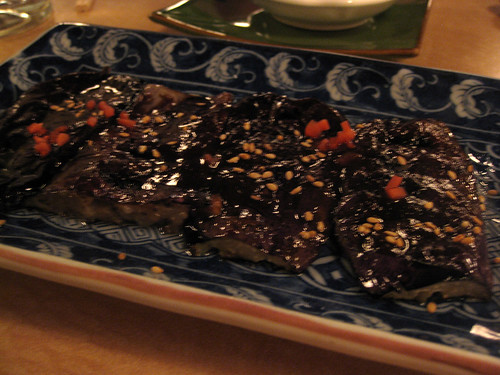
Eggplant Dengaku

Grilled and slathered with salty miso, this was rich without being unhealthy. It was good but the eggplant itself wasn’t very flavorful.

Next, we moved on to the sushi.
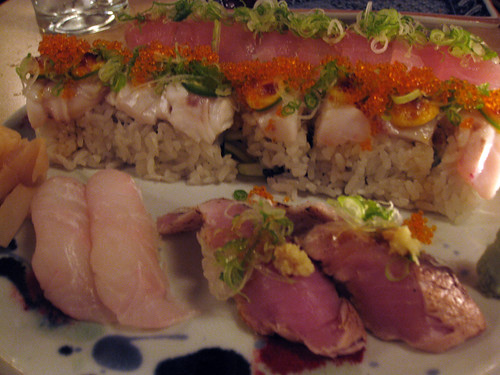
Sushi at Koo

We chose two traditional sets and two inventive rolls: gindara (black cod), maguro (tuna), azteca (crab,avocado, gobo, white fish, jalepeno, spicy mayo, tobiko and ponzu), and flying kamikaze (spicy tuna, asparagus, albacore, garlic ponzu and scallions).

My favorite was the maguro, topped with just a dash of onion and ginger. The gindara was good too – not a whole lot of flavor but chewy and interesting in texture. (To be fair, my dining companion didn’t care so much for it.) The flying kamikaze was delicious too (again, I love tuna), and the azteca was unique but too mayonnaisey for me and the spiciness overpowered the fish.

For dessert, we split a dish of mango and strawberry mochi ice cream with cookies.
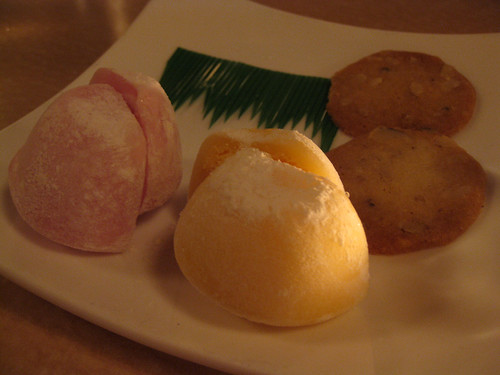
Mochi Ice Cream

It was a simple, refreshing palate cleaner to our meal. I should note that service is great at Koo too – friendly without being pushy and despite the busy atmosphere, we never felt rushed.

I can’t wait to go back to Koo again. The next time I visit, I know I’m trying their spoonful of happiness (a spoonful of uni, quail egg, tobiko ponzu and a spoonful of ankimo wrapped with whitefish, white truffle-oil ponzu and a shot of chilled sake). Their catch of the day menu changes seasonally too so I’m looking forward to what’s in store. That’s what’s great about Koo: you don’t have to choose sides. There’s something for everyone.
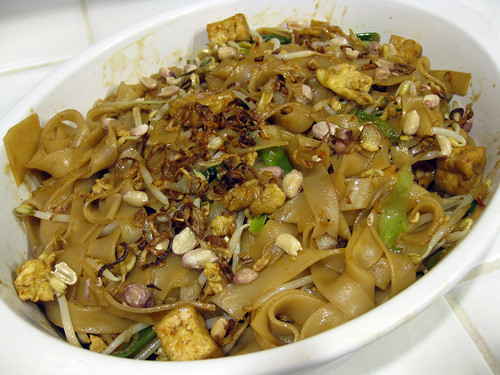
Tofu Pad Thai

Posted on

I’ve struggled with homemade pad Thai. After trying to recreate it at home several times over the years, I sort of gave up and assumed I’d never be able to cook restaurant-style pad Thai at home.

That is, until I tried this recipe, adapted from the now-defunct Gourmet magazine. I didn’t have high hopes – after all, where was the shrimp? But despite the lack of meat, this rendition is full of flavor, texture, and best of all, it actually tastes like classic pad Thai.

Tamarind is essential to this dish so I don’t recommend substituting with similar flavors. And don’t be put off by the large volume of shallots – the first time I made this dish I only wished I’d fried up more crispy slices.

Tofu Pad Thai

Ingredients:

12 ounces dried flat rice noodles (1/4 inch wide)
3 tablespoons tamarind (from a pliable block)
1 cup boiling-hot water
1/2 cup soy sauce
1/4 cup packed light brown sugar
1 1/2 tablespoons chili garlic sauce
1 bunch green onions
4 shallots
1 16-ounce package firm tofu
1 cup vegetable oil
6 eggs
4 garlic cloves, finely chopped
2 cups bean sprouts
1/2 cup roasted peanuts, coarsely chopped

1. Soak noodles in a large bowl of warm water until softened, 20 minutes. Drain in a colander and set aside.

2. Meanwhile, make sauce by soaking tamarind pulp in boiling-hot water in a small bowl, stirring occasionally, until softened, about 5 minutes. Force mixture through a sieve into a bowl, discarding seeds and fibers. Add soy sauce, brown sugar, and chili garlic sauce, stirring until sugar has dissolved.

3. Cut green onions into 2-inch pieces. Cut shallots crosswise into very thin slices. Rinse tofu, then cut into 1-inch cubes and pat dry.

4. Heat oil in wok over medium heat until hot, then fry half of shallots over medium-low heat, stirring frequently, until golden-brown, 8 to 12 minutes. Strain mixture through a fine-mesh sieve into a bowl. Reserve shallot oil and spread fried shallots on paper towels. (Shallots will crisp as they cool.) Wipe wok clean.

5. Reheat shallot oil in wok over high heat until hot. Fry tofu in 1 layer, gently turning occasionally, until golden, 5 to 8 minutes. Transfer tofu to paper towels using a slotted spoon. Pour off frying oil and reserve.

6. Lightly beat eggs with 1/4 teaspoon salt. Heat 2 tablespoons shallot oil in wok over high heat until it shimmers. Add eggs and swirl to coat side of wok, then cook, stirring gently with a spatula, until cooked through. Break into chunks with spatula and transfer to a plate.

7. Heat wok over high heat, pour in 4 tablespoons shallot oil, then swirl to coat side of wok. Stir-fry scallions, garlic, and remaining uncooked shallots until softened, about 1 minute.

8. Add noodles and stir-fry over medium heat for 3 minutes. Add tofu, bean sprouts, and 1 1/2 cups sauce and simmer, turning noodles over to absorb sauce evenly, until noodles are tender, about 3 minutes.

9. Stir in additional sauce if desired, then stir in eggs and transfer to a large shallow serving dish. Sprinkle pad Thai with peanuts and fried shallots and serve.